


Spousal deportation defense is a legal process that challenges or delays the removal of a married non-citizen from the United States, often using the U.S. citizen or lawful resident spouse’s status as a foundation for relief. Acting quickly can be the difference between keeping your family together in Texas and facing a separation that lasts years.

This guide focuses specifically on Texas families facing an active deportation order or removal proceeding against a spouse, and the concrete steps they can take right now.
If immigration enforcement has contacted your household, or if an immigration judge has issued a removal order against your husband or wife, the clock is already running. Families in Sugar Land, Houston, and across Fort Bend and Harris Counties deal with this situation more often than most people realize. And the worst thing you can do is wait.
Why Spousal Deportation Hits Texas Families So Hard
Texas has one of the largest immigrant populations in the country, and mixed-status families here face real, immediate pressure from immigration enforcement that families in other states may not feel as acutely.
When your spouse receives a removal order, it does not just affect them. Your children, your mortgage, your shared finances, your entire life in Texas is on the line. The legal system does offer options, but those options narrow fast once a formal order is in place.
Cancellation of Removal: A legal defense available to certain non-citizens in removal proceedings that allows an immigration judge to cancel the removal order if specific eligibility requirements are met, including continuous physical presence and proof of hardship to qualifying U.S. citizen or lawful permanent resident family members.
Thinking about this for your situation? Let’s talk. Contact us for a direct conversation about what options actually apply to your spouse’s case. No pressure, no runaround.
Spousal Deportation Defense vs. Doing Nothing – A Clear Comparison
Where active legal defense succeeds: It can pause removal proceedings through appeals or motions to reopen, establish eligibility for cancellation of removal, pursue adjustment of status through a U.S. citizen spouse, and document the extreme hardship your family would suffer.
Where active legal defense has limits: It cannot guarantee outcomes. Prior criminal convictions, previous deportation orders, or fraud on prior applications can severely restrict available options. Time is also a hard constraint.
Where doing nothing fails completely: Without intervention, a removal order becomes final. Once your spouse is removed, re-entry bars ranging from 3 years to permanent can apply. Rebuilding your family’s life in Texas becomes dramatically harder and more expensive.
Where doing nothing has zero upside: There is no scenario where ignoring a removal order improves your family’s situation.
The verdict: Even in cases that look difficult, a formal legal review is essential. Some families discover relief options they did not know existed. Others at least gain time to prepare. Either outcome is better than a default removal.
| Relief Option | General Cost Range (2025) | Timeline | Best For |
|---|---|---|---|
| Cancellation of Removal | $3,000 – $8,000+ | Months to years | Long-term residents with U.S. family ties |
| Adjustment of Status | $2,000 – $6,000+ | 1 – 3 years | Immediate relatives of U.S. citizens |
| Motion to Reopen | $1,500 – $5,000+ | 6 – 18 months | New evidence or changed circumstances |
| Appeal to BIA | $2,500 – $7,000+ | 1 – 2 years | Legal errors in original hearing |
Costs above reflect general industry ranges and do not represent the fees of any specific attorney. Actual costs vary based on case complexity.
Your Spousal Deportation Action Plan
- Step 1 – Secure all documents immediately: Gather your spouse’s immigration documents, the removal order, any prior USCIS correspondence, and your marriage certificate. Missing paperwork causes delays that can cost you critical filing windows.
- Step 2 – Do not miss any check-in dates: If your spouse is on supervised release or has scheduled ICE check-ins, missing them triggers immediate detention. Keep every appointment until legal counsel advises otherwise.
- Step 3 – Contact an immigration attorney the same day: Deadlines for filing a motion to reopen or an appeal to the Board of Immigration Appeals (BIA) can be as short as 30 days from the date of the removal order.
- Step 4 – Document your family hardship in writing: Courts consider the hardship that deportation would cause to qualifying U.S. citizen or permanent resident family members. Start collecting school records, medical records, financial statements, and letters from community members now.
- Step 5 – Explore adjustment of status if eligible: If you are a U.S. citizen or lawful permanent resident, your spouse may qualify for an adjustment of immigration status as a defense pathway, even during removal proceedings in some circumstances.
Documents You Need to Gather Right Now
- Copy of the immigration judge’s removal order
- Your spouse’s passport and any valid visas
- Marriage certificate (certified copy)
- Birth certificates for any U.S. citizen children
- Proof of continuous residence (lease agreements, tax returns, utility bills)
- Any prior immigration applications and approval notices
- Evidence of community ties (employment records, school enrollment, church membership)
- Medical records if health-related hardship is a factor
Common Mistakes That Destroy Cases Before They Start
The most common mistake families make is assuming the process is over once an order is issued. A removal order is serious, but it is not always the final word. The second most damaging mistake is hiring someone who is not a licensed immigration attorney. Notarios and unlicensed consultants have cost Texas families their only legitimate shot at relief.
- Missing the 30-day appeal deadline to the BIA
- Failing to disclose prior immigration violations or criminal history to your attorney
- Assuming a U.S. citizen spouse automatically stops deportation proceedings
- Submitting incomplete hardship documentation
See how our approach to immigration defense compares. Visit The Gulley Law Firm, LLC for a full overview of how we handle these cases across Harris County, Fort Bend County, and surrounding communities.
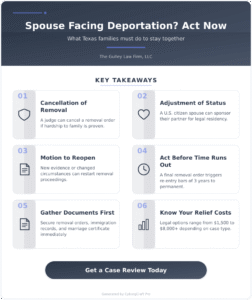
Key Takeaways for Texas Families in 2025
- Time is the most critical factor – appeal and motion deadlines are often 30 days or less from the removal order date
- A removal order is not always final – motions to reopen and BIA appeals are legitimate paths forward
- Hardship documentation matters enormously – the more evidence you build, the stronger your case becomes
- Unlicensed help causes irreversible harm – only work with a licensed Texas immigration attorney
- Your spouse’s eligibility for adjustment of status may still exist – even during active removal proceedings in some cases
Frequently Asked Questions
Does being married to a U.S. citizen automatically stop deportation?
No, marriage to a U.S. citizen does not automatically halt a removal order. It may create eligibility for certain relief options, but those must be actively pursued through the immigration court. An attorney needs to file the appropriate motions to use that marital status as a legal defense.
How long does a spousal deportation defense case take in 2025?
Timelines vary widely depending on the relief pursued, ranging from several months for emergency stays to two or more years for full BIA appeals. Current immigration court backlogs in Texas are significant, which can extend timelines. Acting fast at the start gives your case the most breathing room.
Can my spouse be detained while the case is pending?
Yes, immigration enforcement can detain a person with an active removal order at any time. Filing a motion to reopen or an appeal does not guarantee release from detention, but certain motions can include a request for a stay of removal that may prevent the deportation itself while the case is reviewed.
What is extreme hardship and how does it affect a case?
Extreme hardship refers to the unusually severe impact that deportation would cause to a qualifying U.S. citizen or permanent resident family member. Courts look at financial dependence, health conditions, children’s needs, and community ties. Strong documentation of hardship significantly improves eligibility for cancellation of removal.
What happens if my spouse was already removed from the U.S.?
A person who has already been physically removed may still have options, including consular processing or motions filed in absentia, but the path becomes considerably harder. Re-entry bars of 3, 10, or even permanent duration may apply depending on prior history. Consulting an attorney about the specific facts is essential.
How do I find out if my spouse qualifies for cancellation of removal?
Cancellation of removal requires at least 10 years of continuous physical presence in the U.S., good moral character, and proof of exceptional hardship to a U.S. citizen or permanent resident spouse, parent, or child. Eligibility depends heavily on your spouse’s specific history. A review of their full immigration record is the only way to know for certain.
Your Next Step – Texas Families Cannot Afford to Wait
Removal orders move fast in 2025. Courts are not slowing down, and enforcement actions across Fort Bend County and Harris County are real. The families who protect their life here are the ones who act before the window closes, not after.
At The Gulley Law Firm, LLC, located in Sugar Land, TX, Miechia L. Gulley works directly with families facing these exact situations. The goal is honest, direct representation that actually makes you feel heard and understood, not just processed.
Ready to fight for your family? Contact us today at (832) 990-2116 for a real conversation about your spouse’s case. The sooner you call, the more options you have.
This content is for general informational purposes only and does not constitute legal advice. Immigration law is complex and fact-specific. Please consult a licensed immigration attorney regarding your individual circumstances.