


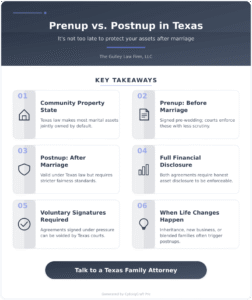
A prenuptial agreement is a legal contract signed before marriage that outlines how assets and debts will be divided if the marriage ends. A postnuptial agreement does the same thing, but the couple signs it after they are already married.

This guide focuses specifically on Texas couples weighing prenup vs. postnup options, including when each makes sense and what Texas law actually requires.
Postnuptial Agreement Definition: A postnuptial agreement is a written contract entered into by two married spouses that defines property rights, debt responsibility, and financial expectations during and after the marriage.
More Texas couples are having this conversation than you might expect. And it is not just high-net-worth households. Business owners, blended families, and couples navigating a major life change are all asking the same question: is it too late to get legal protection if we are already married? The short answer is no. But the details matter a lot under Texas law.
Why Texas Makes This Conversation Different
Texas is a community property state. Under current Texas law (2025), most assets and debts acquired during the marriage are considered jointly owned, regardless of who earned the money or whose name is on the account. That default rule applies unless you have a written agreement that says otherwise.
According to the State Bar of Texas, marital property agreements – both pre and post – are governed by the Texas Family Code and must meet specific requirements to be enforceable. Couples in Fort Bend County, Harris County, and throughout the Sugar Land area are increasingly turning to postnuptial agreements as financial situations change after the wedding.
The most common mistake we see is assuming that a verbal understanding between spouses carries legal weight. It does not. Without a signed, written agreement that meets Texas statutory requirements, the community property rules apply by default.
Thinking about whether a prenup or postnup applies to your situation? Let’s talk. Contact us and we will walk through your options with no pressure and no legal jargon.
Prenup vs. Postnup: Which Approach Works?
| Factor | Prenuptial Agreement | Postnuptial Agreement |
|---|---|---|
| Timing | Before marriage | After marriage |
| Texas Cost Range (2025) | Varies based on complexity and attorney | Varies based on complexity and attorney |
| Enforceability | Well-established in Texas courts | Valid but courts scrutinize more closely |
| Best For | Pre-marriage asset protection, business interests | Inheritance changes, business growth after marriage |
| Required Elements | Voluntary, written, signed by both parties | Voluntary, written, signed, fair disclosure required |
Where prenups succeed: They are executed with less legal scrutiny because neither party is yet bound by marital obligations. Courts generally enforce them when both parties signed voluntarily and disclosed assets honestly.
Where prenups fail: If one partner signed under pressure or without adequate time to review, a Texas court may void the agreement. Agreements signed the night before the wedding are a red flag.
Where postnups succeed: They allow couples to address situations that arose after the wedding – an inheritance, a new business, or a financial reset after a hardship. They can also formalize what a couple has already informally agreed on.
Where postnups fail: Texas courts hold postnuptial agreements to a higher standard of fairness. If one spouse had no legal representation or was pressured during a difficult period in the marriage, courts are more likely to reject the agreement.
The verdict: If you are not yet married, a prenup is the cleaner and more predictable path. If you are already married, a postnup is absolutely a valid tool under Texas law – it just requires careful drafting and full financial disclosure from both sides.
When Couples Typically Start Asking These Questions
Most couples do not think about marital agreements until something changes. Recent data shows that postnuptial agreement requests tend to spike after a few specific life events. Here are the most common triggers:
- One spouse inherits money or property and wants to keep it separate
- A spouse starts or expands a business during the marriage
- The couple goes through a rough patch and reconciliation comes with new financial terms
- A blended family situation requires clarity about what goes to children from a prior relationship
- One spouse accumulates significant debt and the other wants protection
Firms that handle these matters consistently find that couples who address financial agreements proactively tend to experience less conflict if the marriage does end. The agreement itself becomes a communication tool, not just a legal document.
Your Postnup Action Plan
- Step 1 – Inventory Your Assets: List all separate and community property, including real estate, retirement accounts, business interests, and debts. Both spouses need to participate honestly.
- Step 2 – Identify Your Goals: Are you protecting a business? Clarifying inheritance rights? Defining what happens if one spouse stops working? Get specific.
- Step 3 – Hire Separate Attorneys: Texas courts look more favorably on postnups when each spouse had independent legal counsel. This is not optional if you want the agreement to hold up.
- Step 4 – Draft and Review: Your attorney drafts the agreement. Both parties review it carefully. No one should sign under time pressure.
- Step 5 – Execute Properly: The agreement must be in writing and signed by both spouses. Consult with your attorney about any additional execution requirements that may apply and what is recommended for evidentiary purposes.
- Step 6 – Store and Update: Keep the signed agreement in a secure location. Revisit it after major life changes such as a new child, a property purchase, or a significant shift in income.
What Texas Courts Actually Look At
Not every postnuptial agreement survives a legal challenge. Texas courts evaluate these agreements for voluntariness, fairness, and full disclosure. According to general family law standards, an agreement is more likely to be enforced when:
- Both spouses had time to consult with their own attorneys
- Neither party was under financial or emotional duress at signing
- All assets and debts were disclosed before signing
- The terms are not shockingly one-sided
The most common reason postnups get thrown out is that one spouse did not fully understand what they were agreeing to. That is why working with a family law attorney who understands Texas marital property law matters – not just any general practice attorney.
See how our approach to marital agreements works for Texas families. Get more information about your specific situation before you sign anything.
Key Takeaways for Texas Couples in 2025
- Postnups are fully valid in Texas – being already married does not close the door on a marital property agreement
- Community property rules are the default – without a written agreement, Texas splits most marital assets 50/50
- Separate legal counsel matters – courts scrutinize postnups more closely than prenups, so independent representation protects both parties
- Timing is everything – agreements signed during conflict or crisis are the most vulnerable to legal challenge
- These agreements can be updated – life changes, and your agreement can change with it
Frequently Asked Questions
Is a postnuptial agreement enforceable in Texas?
Yes, postnuptial agreements are enforceable in Texas when properly drafted, voluntarily signed, and supported by full financial disclosure. Texas Family Code Chapter 4 governs these agreements. Courts will scrutinize them for fairness, especially if one spouse lacked independent legal advice.
How much does a postnuptial agreement cost in Texas?
Postnuptial agreement costs in Texas vary depending on the complexity of the situation and the attorneys involved. Factors like the number of assets involved, whether both parties have attorneys, and how quickly the agreement is needed all affect the final cost.
Can a postnup protect a business started during marriage?
Yes, a postnuptial agreement can designate a business started during the marriage as separate property or define each spouse’s interest in it. Without such an agreement, a business built during marriage is generally considered community property under Texas law, meaning both spouses have an ownership stake.
What is the difference between separate and community property in Texas?
Separate property is what you owned before marriage or received as a gift or inheritance, while community property is most of what either spouse earns or acquires during the marriage. A prenup or postnup can convert community property to separate property or vice versa, as long as both parties agree in writing.
Do both spouses need their own attorney for a postnup in Texas?
Texas law does not require separate attorneys, but courts view postnups much more favorably when each spouse had independent legal counsel. If one spouse later claims they did not understand the agreement, having their own attorney on record makes that argument much harder to support.
How long does it take to finalize a postnuptial agreement in Texas?
A straightforward postnuptial agreement can be completed in 2 to 6 weeks once both spouses are ready to move forward. Complex agreements involving businesses, real estate, or significant assets may take longer. Rushing the process creates risk – courts do not look favorably on agreements signed under pressure.
Can a prenup or postnup cover child custody or child support?
No – neither prenuptial nor postnuptial agreements can legally predetermine child custody or child support arrangements in Texas. Those decisions are always made by a court based on the best interests of the child at the time of any proceeding. Marital agreements are limited to property and financial matters between the spouses.
Your Next Step
Whether you are newly married or have been together for years, there is no wrong time to get clarity on how your finances are protected. At The Gulley Law Firm, LLC, based in Sugar Land, TX, we help couples throughout Fort Bend County and Harris County understand their options and put agreements in place that actually hold up. We work with real people who have real questions – and we explain things in plain language, not legal boilerplate.
Ready to take the next step? Contact us today for straight answers about marital agreements in Texas. The sooner you have this conversation, the more options you have.
This content is provided for general informational purposes and does not constitute legal advice. Laws vary and your specific situation may differ. Consult a licensed Texas attorney for advice tailored to your circumstances.