


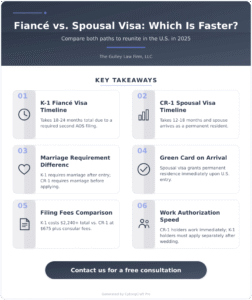
This guide focuses specifically on couples weighing both options in 2025 so they can make a clear-headed decision without wading through government jargon.
Definition: A fiancé visa (K-1) allows a foreign-national partner to enter the U.S. to marry a U.S. citizen within 90 days, while a spousal visa (CR-1 or IR-1) allows an already-married couple to reunite permanently in the United States.
The fiancé visa vs. spousal visa debate is not just about paperwork. It is about real time spent apart, real money spent on fees, and real consequences for your family’s future. The most common mistake couples make is assuming one path is always faster without looking at their specific situation. From what immigration attorneys regularly see, many couples choose the K-1 fiancé visa expecting speed, only to discover the total time to a green card is actually longer than the spousal route.
How the Fiancé Visa (K-1) Actually Works
The K-1 fiancé visa is a nonimmigrant visa that lets your foreign partner enter the U.S. for one purpose – to marry you within 90 days.
Here is the sequence:
- File Form I-129F: The U.S. citizen files a petition with USCIS. Current processing runs roughly 6-9 months as of early 2025.
- National Visa Center (NVC) processing: Once approved, the case transfers to NVC, adding a few weeks.
- Consular interview abroad: Your partner attends an interview at a U.S. embassy or consulate in their country.
- Enter the U.S. and marry within 90 days: Once inside the country, you must marry before the visa expires.
- File for Adjustment of Status (AOS): After marriage, your partner files Form I-485 to get a green card – an additional 8-14 months in 2025.
Total realistic timeline from start to green card: 18-24 months in many cases.
How the Spousal Visa (CR-1 / IR-1) Actually Works
The CR-1/IR-1 spousal visa is an immigrant visa for couples who are already legally married. Your spouse enters the U.S. as a permanent resident, skipping the Adjustment of Status step entirely.
The sequence looks like this:
- File Form I-130: The U.S. citizen or green card holder files a petition. Processing currently runs 6-12 months (2025).
- NVC processing and fee payment: Several weeks of document collection and review.
- Consular interview abroad: Your spouse interviews at the U.S. embassy or consulate.
- Enter the U.S. as a permanent resident: Your spouse arrives with an immigrant visa that converts to a green card automatically.
Total realistic timeline: 12-18 months for most couples in 2025 – and your spouse arrives already holding permanent residence status.
Thinking about this for your situation? Let’s talk. Contact us and we will walk you through your options with no pressure. You can also learn more about our approach at The Gulley Law Firm, LLC.
Fiancé Visa vs. Spousal Visa: Which Approach Works?
| Factor | K-1 Fiancé Visa | CR-1/IR-1 Spousal Visa |
|---|---|---|
| Must be married first? | No | Yes |
| Initial USCIS processing (2025) | 6-9 months | 6-12 months |
| Green card on arrival? | No – must file AOS after wedding | Yes |
| Total time to green card | 18-24 months | 12-18 months |
| Government filing fees (approx.) | $800+ for I-129F + $1,440 AOS (2025) | $675 for I-130 + consular fees (2025) |
| Work authorization on arrival? | Must apply separately after entry | Immediate – arrives as LPR |
| Best for | Couples not yet married who want flexibility | Already-married couples prioritizing speed |
Where the K-1 fiancé visa succeeds: Great for couples who want to marry in the U.S., involve family in the wedding, or have not yet wed for personal or cultural reasons.
Where the K-1 fiancé visa fails: The two-step process (visa + Adjustment of Status) adds months and significant filing fees. Your partner cannot work legally the moment they arrive.
Where the CR-1/IR-1 spousal visa succeeds: Your spouse arrives as a permanent resident with immediate work authorization. No second filing required after arrival.
Where the CR-1/IR-1 spousal visa fails: You must already be married, which is not always logistically or personally possible before starting the process.
The verdict: For couples already married or willing to marry abroad, the spousal visa is almost always the faster overall path to permanent residence in the U.S. The K-1 makes sense when marriage in the U.S. is a firm priority.
According to the U.S. Department of State, immigrant visa processing times vary by consulate and case complexity – always check current wait times for your partner’s specific country.
Costs Couples Overlook
Filing fees are only part of the picture. Here is what often catches people off guard:
- Medical exam fees (required at an approved physician abroad) – typically $200-$500
- Document translation and notarization costs
- Travel for consular interviews
- Attorney fees if your case has complications
- Biometrics fees and additional USCIS service fees
Recent data shows the total out-of-pocket cost for a K-1 path through green card routinely reaches $3,000-$5,000 or more when all steps are included. The CR-1 path tends to run $2,000-$3,500 for straightforward cases – lower largely because it eliminates the Adjustment of Status filing.
Your Fiancé or Spousal Visa Action Plan
- Confirm your marital status: Are you already married? If yes, the CR-1/IR-1 is likely your fastest route. If not, decide whether marrying abroad first makes sense.
- Check your partner’s country processing times: Some U.S. embassies move faster than others. This can genuinely shift which path is quicker for your specific situation.
- Gather key documents early: Birth certificates, passports, proof of relationship, and evidence of financial support. Delays almost always trace back to missing paperwork.
- File accurately and completely: Incomplete petitions are the single biggest cause of requests for additional evidence (RFEs), which add months to any timeline.
- Consult an immigration attorney before filing: If either partner has a prior visa issue, prior removal, or a criminal record – even minor – get legal guidance before you submit anything.
For more detail on related immigration matters, explore our Adjustment of Immigration Status services or our Deportation Defense page for situations where immigration status becomes more complicated.
Frequently Asked Questions
Which visa gets my partner to the U.S. faster – the K-1 or the CR-1?
For most couples in 2025, the CR-1 spousal visa results in a faster path to permanent residence overall. While initial petition timelines are similar, the K-1 requires a second filing after marriage, adding 8-14 months before your partner holds a green card.
Can my fiancé work in the U.S. while on a K-1 visa?
A K-1 visa holder cannot work immediately upon arrival – they must first marry and then apply for an Employment Authorization Document (EAD). This process currently takes several months with USCIS, meaning a gap in work authorization is common.
Do I have to marry in the U.S. to use the spousal visa?
No – the CR-1/IR-1 spousal visa requires only that you are legally married, regardless of where the wedding took place. Couples who marry abroad can immediately pursue the spousal immigrant visa without returning to the U.S. first.
What happens if we do not marry within 90 days on a K-1 visa?
If the 90-day period expires without a legal marriage, the K-1 holder must leave the United States. Overstaying creates serious immigration consequences, including potential bars to future visa eligibility.
How much does an immigration attorney charge for these cases?
Attorney fees for fiancé and spousal visa cases typically range from $1,500 to $4,000 nationally for straightforward petitions, though complex cases run higher. These are general industry ranges – individual attorneys set their own fee structures, and many offer payment arrangements.
Can green card holders file for a fiancé visa?
No – the K-1 fiancé visa is only available to U.S. citizens, not lawful permanent residents (green card holders). Green card holders must file an I-130 spousal petition, which also falls under a different visa preference category with longer wait times.
Your Next Step
If you and your partner are separated by borders and trying to figure out the fastest, safest path forward, you do not have to sort through government websites alone. The rules change, processing times shift in 2025 and heading into 2026, and one filing error can set you back significantly.
At The Gulley Law Firm, LLC, located in Sugar Land, TX and serving clients throughout Fort Bend County, Harris County, and the surrounding region, attorney Miechia L. Gulley works directly with clients who are serious about getting results. The firm takes a straightforward, personal approach – real conversations, clear explanations, and flexible payment options.
Ready to take the next step? Contact us today for straight answers about your specific situation. Immigration timelines do not wait, and starting sooner almost always means being together sooner.