


Child Support in Texas – Definition: A periodic payment ordered by a Texas family court requiring one parent to contribute financially to the care and upbringing of a child, calculated under the Texas Family Code Section 154 guidelines using net resources and a percentage-based formula.
A lot of parents come into this process thinking it’s simple – twenty percent for one kid, done. And honestly, that’s a reasonable assumption. The state does use a percentage structure. But the word “net” does a lot of heavy lifting here, and what counts as “net resources” under Texas law is not the same as your take-home pay. Understanding this distinction can mean the difference between an order that feels fair and one that feels impossible.
How Child Support in Texas Is Actually Calculated
The Texas Family Code sets the baseline percentages. According to the Texas Family Code Section 154, the guidelines are:
- 1 child: 20% of net resources
- 2 children: 25% of net resources
- 3 children: 30% of net resources
- 4 children: 35% of net resources
- 5 or more children: 40% of net resources
The maximum net monthly resources cap is $11,700 effective September 1, 2025, for applicable orders (previously $9,200). Under the $11,700 cap effective September 1, 2025, maximum guideline support for one child is $2,340 per month regardless of how much more the obligor earns above that cap.
Net Resources Defined: Under Texas law, net resources include wages, salary, self-employment income, rental income, retirement, and interest – minus Social Security taxes, federal and state income taxes (based on a single person with one exemption), and union dues.
Health insurance premiums paid for the child are also factored in. This is not simply a deduction from gross pay, and many parents get tripped up here when they try to estimate their own support obligation.
What Raises or Lowers the Amount a Court Orders
Here’s where it gets more nuanced. Texas courts can deviate from the guideline amount when the facts of the case warrant it. The most common mistake parents make is assuming the guideline number is always the final number. It isn’t.
Factors that can increase or decrease child support include:
- The age and specific needs of the child, including medical conditions or disabilities
- Whether the paying parent supports other children in or outside the household
- The amount of time each parent spends with the child (possession schedule)
- Travel costs required for visitation across long distances
- Educational expenses beyond standard public school costs
- Significant income disparity between the parents
When a paying parent has children from multiple relationships, the court uses an adjusted percentage. If you support two kids with one partner and have one child with another, the court doesn’t simply add the percentages together. Texas has a specific formula for this scenario laid out in the Family Code.
Thinking about this for your situation? Let’s talk. At The Gulley Law Firm, LLC, we walk clients through their numbers before they ever set foot in a courtroom. Contact us to schedule a conversation – no pressure, just real answers.
Guideline Support vs. Agreed Support: Which Approach Works?
Where guideline support succeeds: It provides predictability, reduces courtroom conflict, and gives both parents a legally defensible baseline. Judges in Fort Bend County and Harris County routinely approve guideline orders without extended hearings.
Where guideline support fails: It doesn’t always account for unusual expenses, variable income like commission-based jobs, or situations where one parent carries significantly more of the childcare burden. It can also feel rigid when circumstances change quickly.
Where agreed support succeeds: Parents who negotiate their own amount (with attorney guidance) can build in provisions for extracurriculars, healthcare, college savings, and schedule changes. Courts generally approve agreed orders as long as they serve the child’s best interest.
Where agreed support fails: Without proper legal structure, informal agreements aren’t enforceable. If your co-parent stops paying what you both verbally agreed to, the court will default back to whatever the formal order says.
The verdict: Guideline support is a solid starting point. But parents with complex income, multiple children, or significant shared custody time should absolutely get legal help to evaluate whether a deviation serves everyone better.
| Factor | Guideline Order | Agreed/Modified Order |
|---|---|---|
| Predictability | High | Varies |
| Flexibility | Low | High |
| Court approval needed | Yes | Yes |
| Best for | Standard income, routine custody | Complex finances or shared parenting |
Your Child Support Action Plan
- Step 1 – Gather income documents: Collect your last 3 months of pay stubs, most recent tax return, and any documentation of other income sources. This is what the court will use to calculate net resources.
- Step 2 – Account for other children: If you support children outside this case, pull their court orders. The adjusted percentage calculation requires documentation.
- Step 3 – Review your possession schedule: Standard possession and extended standard possession affect deviation arguments. Know which schedule applies to your case.
- Step 4 – Calculate insurance costs: Document what you currently pay for the child’s health insurance. This offsets support calculations.
- Step 5 – Consult an attorney before agreeing to anything: An informal number that sounds reasonable now can cause serious problems if circumstances change and it was never formalized.
What to Gather Before Your Consultation
- ☐ Last 3 pay stubs from each parent
- ☐ Most recent federal tax return
- ☐ Documentation of any self-employment income
- ☐ Current health insurance premium statements
- ☐ Any existing court orders for other children
- ☐ Current or proposed possession schedule
- ☐ Documentation of extraordinary child expenses
According to the Texas Law Help resource published by legal aid organizations across the state, the most common reason parents request a child support modification in 2025 is a substantial change in income – either a job loss or a significant raise. Courts require at least a 20% or $100 change (whichever is greater) in the calculated amount before they’ll modify an existing order.
See how The Gulley Law Firm, LLC approaches family law cases differently – visit our services overview or reach out directly to talk through your specific situation.
Key Takeaways for Texas Parents in 2025
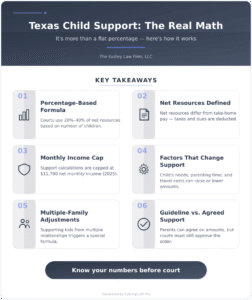
- The percentage applies to net resources, not gross income – these numbers are often very different
- The net resources cap increased to $11,700 per month effective September 1, 2025 – earnings above that don’t increase the guideline amount
- Multiple children from different relationships trigger an adjusted formula, not simple addition
- Courts can deviate from guidelines when the child’s best interest requires it
- Informal agreements are not enforceable – always get a formal court order
Frequently Asked Questions
How does Texas calculate child support for self-employed parents?
Self-employed parents use their net profit from Schedule C or business returns to determine net resources, minus allowable taxes. Courts often scrutinize business deductions carefully to ensure income isn’t being artificially reduced. Keeping clean financial records matters significantly here.
Can child support in Texas be modified after it’s ordered?
Yes, Texas allows modification when there has been a material and substantial change in circumstances since the last order was signed. The most common triggers are job changes, a significant shift in the child’s needs, or a change in custody. The requesting parent must petition the court and demonstrate the change meets the legal threshold.
What happens if a parent refuses to pay child support in Texas?
Non-payment can result in wage garnishment, license suspension, tax refund interception, and even contempt of court charges. Texas has one of the more aggressive enforcement systems in the country, and the Office of the Attorney General actively pursues collections on behalf of custodial parents.
Does shared custody reduce child support in Texas?
Shared custody does not automatically reduce child support, but it can support a deviation argument. If a parent has the child significantly more than the standard schedule, an attorney can petition for an adjustment based on the actual possession time and expenses carried by each parent.
How much does a child support attorney typically cost in Texas?
Attorney fees for child support cases in Texas generally range from $1,500 to $5,000+ depending on case complexity and whether it goes to a hearing. These are general industry ranges – each attorney sets their own fees. Many attorneys, including those at The Gulley Law Firm, LLC, work with clients on payment arrangements to make representation accessible.
Does child support cover private school or extracurricular activities?
Standard guideline support covers basic necessities, but Texas courts can order additional contributions for extraordinary expenses like private school tuition or medical needs. These are handled separately from the base support calculation and typically require agreement between parents or a specific court order.
Your Next Step
Child support orders shape daily life for years. Getting the calculation right from the start – or fixing an outdated order that no longer reflects your reality – is worth doing carefully. Parents throughout Sugar Land, Richmond, Missouri City, Stafford, and across Fort Bend and Harris County turn to The Gulley Law Firm, LLC for straightforward guidance on exactly this kind of situation.
Ready to get clarity on your specific numbers? Contact us today and get real answers without the runaround. The firm serves clients within a 50-75 mile radius of Sugar Land, TX, and is reachable at (832) 990-2116 during business hours.
This content is for general informational purposes only and does not constitute legal advice. Child support laws are subject to change, and individual circumstances vary. Consult a licensed Texas family law attorney regarding your specific situation.