


 Adjustment of immigration status during divorce is the legal process of changing your immigration classification in the U.S. while simultaneously managing the dissolution of a marriage – two separate legal tracks that can collide in ways that catch people completely off guard. Getting the timing wrong on either case can jeopardize both your residency and your divorce outcome.
This guide focuses specifically on Texas residents who are managing an active immigration adjustment case and a pending divorce at the same time.
Definition: Adjustment of immigration status is the process by which an eligible person already inside the United States applies to change from a nonimmigrant or undocumented status to lawful permanent resident status, typically by filing Form I-485 with USCIS.
The most common mistake in these situations is treating both cases as completely separate. They are not. A divorce can directly affect your eligibility for a marriage-based green card. And certain immigration outcomes can affect how Texas family courts view your residency, your finances, and sometimes even custody arrangements. If you are in Fort Bend County, Harris County, or anywhere in the greater Sugar Land area, the stakes are high on both fronts.
How Divorce Affects a Marriage-Based Immigration Case in Texas
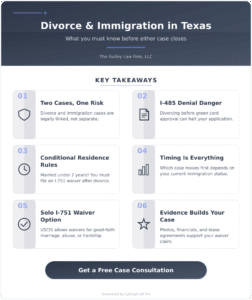
If your green card application is based on marriage to a U.S. citizen or lawful permanent resident, a divorce during the process can stop that application in its tracks – depending on where you are in the timeline.
Conditional permanent residence (CPR): A status granted to spouses who have been married less than two years when the green card is approved, requiring removal of conditions through Form I-751 within the two-year period.
According to U.S. Citizenship and Immigration Services (USCIS), if your marriage ends before your I-485 is approved and it was the basis for your petition, USCIS will typically deny the application. There are exceptions – but they require documentation, legal strategy, and often a waiver petition.
Marriage-based adjustment cases can take considerable time to process under current USCIS timelines, and that processing window is exactly the danger zone when a marriage falls apart mid-case.
Thinking about this for your situation? Let’s talk. Contact us for a direct conversation about your options – no pressure, just straight answers.
Divorce Timing vs. Immigration Status: Which Case Should Move First
There is no universal right answer, but here is how the decision typically breaks down.
| Scenario | Immigration Status Risk | Recommended Priority | Notes (2025) |
|---|---|---|---|
| I-485 pending, married less than 2 years | High – application likely denied on divorce | Consult immigration attorney before filing divorce | Waiver options exist in abuse or extreme hardship cases |
| Conditional green card already approved | Medium – must file I-751 waiver without spouse | File I-751 waiver before or during divorce | USCIS accepts good-faith marriage waivers |
| 10-year green card already in hand | Low – divorce has minimal immigration impact | Proceed with divorce normally | Naturalization timelines may be affected |
| Naturalization pending | Low to medium – depends on continuous residence claims | Review N-400 status with attorney | Living separately can affect continuous residence |
Handling Conditional Residence: The I-751 Waiver Path
Where filing jointly succeeds: When both spouses cooperate, the joint petition is faster, more straightforward, and rarely questioned by USCIS.
Where filing jointly fails: If your spouse refuses to sign, has left the country, or the marriage is ending contentiously, a joint petition is not possible.
Where the waiver path succeeds: USCIS does allow solo I-751 waivers based on good-faith marriage, battery or extreme cruelty, or extreme hardship. Evidence matters here – photos, joint financial records, lease agreements, and communications all help.
Where the waiver path fails: Thin documentation, no corroborating evidence of a bona fide marriage, or missing deadlines can result in denial and potential removal proceedings.
The verdict: If your marriage is ending and your conditional green card window is approaching, file the waiver before the deadline regardless of your divorce timeline. Missing the two-year filing window has far worse consequences than a complicated waiver application.
What Texas Family Courts Consider That Immigration Courts Do Not
Texas family courts operate under the Texas Family Code and do not factor in immigration status when dividing marital property or determining conservatorship. That said, a few intersections matter.
- Spousal support agreements can affect how USCIS evaluates your financial self-sufficiency claims in an adjustment application
- If there are children and one parent has uncertain immigration status, courts may factor stability into custody decisions
- Joint tax filings used as immigration evidence can create complications in divorce asset division
- A divorce decree can serve as evidence in an I-751 waiver that a valid marriage existed
The attorneys at The Gulley Law Firm, LLC, serving clients in Sugar Land, TX and surrounding areas in Fort Bend and Harris Counties, handle both family law and immigration cases – which means your two legal tracks are being watched by the same set of eyes.
See how a combined approach can protect both cases – learn more about adjustment of immigration status services.
Your Immigration and Divorce Action Plan
- Step 1 – Identify your current immigration status: Know exactly where your I-485 or conditional green card stands before filing anything in family court.
- Step 2 – Pull your USCIS receipt notices: Confirm filing dates and any pending requests for evidence (RFEs) that could complicate your timeline.
- Step 3 – Gather marriage evidence now: Collect joint bank statements, lease agreements, photos, and correspondence before divorce proceedings make access difficult.
- Step 4 – Consult an attorney before filing the divorce petition: Filing first without a strategy can trigger USCIS scrutiny or cut off options you did not know you had.
- Step 5 – Coordinate both cases intentionally: If possible, time filings so that one case does not create evidentiary problems for the other.
- Step 6 – Monitor both case statuses actively: USCIS processing times shift throughout 2025. Check your case status regularly and respond to any notices within the stated deadlines.
Documents to Gather Before Any Consultation
- ☐ Copy of your I-485, I-130, or current visa documentation
- ☐ USCIS receipt notices for any pending applications
- ☐ Joint tax returns filed during the marriage
- ☐ Joint bank account statements or shared financial records
- ☐ Lease, mortgage, or utility bills showing shared address
- ☐ Photos and communications evidencing the marriage
- ☐ Any prior immigration court orders or removal proceedings records
- ☐ Your Texas divorce petition or temporary orders, if already filed
Key Takeaways for Texas Residents in 2025
- Timing is everything – a divorce filed before your I-485 approval can end your green card case entirely if it was marriage-based
- Conditional green card holders have options – the I-751 waiver path exists specifically for situations where the marriage ends in good faith
- Texas family courts are immigration-neutral – but the financial and custody decisions made there can still affect your USCIS case indirectly
- Evidence preservation matters right now – gather joint marriage documents before the divorce process creates access barriers
- Do not wait on either deadline – both USCIS filing windows and Texas divorce court deadlines can expire without extensions
Frequently Asked Questions
Can a divorce automatically cancel my pending green card application in Texas?
A divorce does not automatically cancel a pending I-485, but it can make USCIS deny it if the application was based on the marriage. Once USCIS learns the marriage has ended, they will typically determine the underlying petition is no longer valid unless you qualify for a waiver or an alternative path to residency exists.
What happens to my conditional green card if my spouse refuses to file the I-751 jointly?
You can file Form I-751 on your own using the waiver provision if your spouse will not cooperate. USCIS accepts solo filings based on a good-faith marriage, extreme hardship, or documented abuse. Strong documentary evidence of the marriage significantly improves waiver outcomes.
How long does adjustment of immigration status take during a divorce in 2025?
USCIS I-485 processing times vary depending on the visa category and service center, and current timelines should be verified directly with USCIS. If a divorce occurs during that window, the timeline can extend further due to additional USCIS review, RFEs, or waiver processing requirements.
Does my immigration status affect how Texas divides marital property?
Texas family courts do not use immigration status as a factor in property division under the Texas Family Code. Community property rules apply regardless of citizenship. However, joint financial documents used in immigration cases can become part of the divorce discovery process.
Can I still apply for naturalization after a divorce in Texas?
Yes, but the timeline may change depending on how you obtained your green card. If you received a green card through marriage to a U.S. citizen, you were eligible to apply for naturalization after three years. After a divorce, you revert to the standard five-year green card holder requirement.
How much does handling both an immigration and divorce case cost in Texas?
Attorney fees for combined immigration and family law representation vary widely based on case complexity. Immigration adjustment cases generally range from $1,500 to $5,000 in attorney fees nationally, while contested Texas divorces can range from $5,000 to $30,000 or more depending on asset disputes and custody issues. Many firms, including The Gulley Law Firm, LLC, offer payment arrangements to help manage costs.
Your Next Step in Sugar Land and Across Fort Bend County
Both cases have deadlines that do not wait for you to feel ready. If your divorce and immigration case are running at the same time right now, the decisions you make in the next few weeks can either protect both outcomes or undermine them. The pattern in these situations is clear: people who get coordinated legal guidance early preserve far more options than those who address each case in isolation after problems develop.
Texas requires at least one spouse to have resided in the state for 6 months and the county for 90 days to file for divorce. Ready to protect both cases? Contact The Gulley Law Firm, LLC today for a direct consultation. The firm serves clients throughout Sugar Land, Richmond, Katy, Missouri City, Stafford, and surrounding areas in Fort Bend and Harris Counties. You can also reach the firm by phone at (832) 990-2116. Do not let either deadline pass before getting the full picture.
This content is for informational purposes only and does not constitute legal advice. Contact a licensed Texas attorney to discuss the specific facts of your case.