


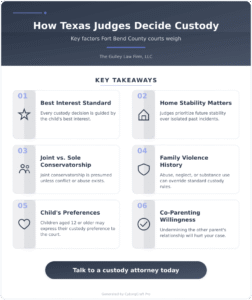
Child custody in Texas divorce cases is determined by a judge using the “best interest of the child” standard, a multi-factor legal test that weighs parental fitness, stability, and the child’s own needs. Getting this wrong can shape your relationship with your children for years.

This guide focuses specifically on how Texas family courts – including Fort Bend County courts – evaluate custody disputes when parents cannot reach an agreement on their own.
Most parents going through a Texas divorce assume the judge will simply “split things down the middle.” That’s rarely how it works. Fort Bend County courts look at a specific set of factors before deciding who gets family law attorney representation matters most – and how those decisions are framed in the courtroom.
The Legal Standard Texas Judges Actually Use
Best Interest of the Child: The governing standard in every Texas child custody case, requiring courts to evaluate parental history, child development, and family stability before issuing any conservatorship or visitation order.
Conservatorship: The Texas legal term for custody, divided into “managing conservatorship” (major decisions) and “possessory conservatorship” (physical time and access).
Texas courts start with a presumption that Joint Managing Conservatorship serves children best. That means both parents share decision-making rights over education, healthcare, and religion. But “joint” does not automatically mean equal time. The primary residence designation – which determines where a child sleeps most nights – is where most custody battles actually happen.
Fort Bend County family courts regularly handle divorce and custody matters, and contested custody cases involve the full best-interest analysis every single time.
The Specific Factors Fort Bend County Judges Weigh
Here is what a judge is actually looking at when you walk into a Fort Bend County courtroom:
- The child’s physical and emotional needs, now and in the future
- Each parent’s ability to meet those needs consistently
- Stability of the home environment each parent can provide
- History of family violence, abuse, or neglect by either parent
- The child’s existing bonds with siblings, extended family, and community
- Each parent’s willingness to support the child’s relationship with the other parent
- The child’s own preferences, if the child is 12 or older
- Any history of drug or alcohol use that affects parenting capacity
The most common mistake parents make is underestimating how much the judge focuses on future stability, not just past behavior. One bad incident matters less than a pattern. And a parent who actively undermines the other parent’s relationship with the child will almost always hurt their own case.
Thinking about how these factors apply to your specific situation? Let’s talk. At The Gulley Law Firm, LLC, we walk you through your options with straight answers – no pressure and no confusing legal jargon.
Joint Managing Conservatorship vs. Sole Managing Conservatorship: Which Applies?
Where Joint Managing Conservatorship succeeds: Both parents can communicate reasonably, there is no history of family violence, and both are actively involved in the child’s life. It preserves both parental relationships and reduces long-term conflict.
Where Joint Managing Conservatorship fails: It breaks down when parents cannot communicate without conflict, when one parent has a history of domestic violence or substance abuse, or when geographic distance makes joint decision-making impractical.
Where Sole Managing Conservatorship succeeds: One parent has significantly better parenting capacity, there is documented abuse or neglect by the other parent, or the family dynamic makes shared authority harmful to the child.
Where Sole Managing Conservatorship fails: Courts are reluctant to cut a parent out entirely without strong evidence. Seeking sole conservatorship without that evidence can make you look unreasonable to the judge.
The verdict: Most Fort Bend County cases resolve with Joint Managing Conservatorship and a Standard Possession Order setting out a predictable parenting schedule. Sole conservatorship is reserved for situations with clear, documented harm to the child.
| Arrangement | Decision-Making | Physical Time | Best For |
|---|---|---|---|
| Joint Managing Conservatorship | Shared by both parents | Determined by order | Cooperative co-parents |
| Sole Managing Conservatorship | One parent controls | Other parent gets visitation | Abuse/neglect situations |
| Standard Possession Order | Follows conservatorship | Alternating weekends, holidays | Most contested Texas cases |
Your Child Custody Action Plan for Fort Bend County
- Step 1 – Document Everything: Start keeping a parenting journal now. Record school pickups, medical appointments, and any incidents that affect your child’s wellbeing. Courts respond to evidence, not assertions.
- Step 2 – Gather Financial Records: Child support calculations in Texas use both parents’ incomes. Pull together pay stubs, tax returns, and any documentation of expenses related to the children.
- Step 3 – Assess Your Living Situation: Judges look at housing stability. Make sure your home environment is safe, appropriate for children, and ready to describe clearly.
- Step 4 – Avoid Social Media Conflicts: Posts about your co-parent, your personal life, or your legal case can and do appear in Texas courtrooms. Keep it private.
- Step 5 – Consult an Attorney Before Filing: The paperwork you file first sets the tone. Getting legal guidance before you submit anything to the Fort Bend County District Clerk can protect your position from day one.
What to Bring to Your First Consultation
- ☐ Marriage certificate and any existing court orders
- ☐ Children’s birth certificates
- ☐ Recent pay stubs or proof of income for both parties if available
- ☐ School and medical records showing your involvement
- ☐ Any documentation of family violence or protective orders
- ☐ A written timeline of major custody-related events
See how our approach compares to handling this alone – explore our family law services or contact us to schedule a consultation with The Gulley Law Firm, LLC in Sugar Land, TX.
Common Mistakes That Hurt Your Custody Case
The most common mistake we see is parents speaking negatively about the other parent in front of the children. Judges take this seriously as evidence of unwillingness to co-parent. The second major error is missing school events, medical appointments, or scheduled visitation – absence creates a record that works against you. Third, parents who move without proper notice violate Texas law and damage their standing in court immediately.
Key Takeaways for Fort Bend County Parents in 2025
- Best interest governs everything – every custody decision in Texas runs through this standard
- Joint conservatorship is the default – courts presume shared decision-making unless there is a compelling reason otherwise
- Your conduct during the divorce matters – how you treat your co-parent signals to the judge how you will co-parent long-term
- Children 12 and older have a voice – Texas courts take their preferences into account, though it is not the final word
- Documentation wins cases – consistent records of your parenting involvement are your strongest asset in a contested hearing
Frequently Asked Questions
How does a Texas judge decide who gets primary custody?
Texas judges assign primary custody based on the best interest of the child standard, reviewing parental stability, involvement history, and the child’s emotional needs. Fort Bend County courts follow the same standard as all Texas family courts under the Texas Family Code. Evidence of consistent parenting, a stable home, and a cooperative attitude toward co-parenting all strengthen your position.
Does Texas favor mothers over fathers in child custody cases?
Texas law does not give preference to either parent based on gender – courts must evaluate both parents equally under current Texas Family Code provisions. In practice, the parent who has been the primary caregiver often has an advantage, but that advantage comes from involvement, not from being a mother or a father.
What age can a child decide which parent to live with in Texas?
At age 12, a Texas child may sign a written statement expressing a preference, which the judge must consider – but the judge is not bound by that preference. The best interest standard still controls. A child’s wishes carry more weight as they get older and can articulate reasons clearly.
How much does a custody attorney cost in Texas?
Family law attorneys in Texas typically charge hourly rates ranging from $200 to $450 per hour, with contested custody cases often requiring retainers of $3,000 to $10,000 or more depending on complexity. These are general industry ranges, not the specific rates of any one firm. Many attorneys, including those serving Fort Bend County, offer payment arrangements to make quality representation accessible.
How long does a Texas custody case take to resolve?
Uncontested divorces with agreed custody terms can finalize in as little as 60 days in Texas, while contested custody cases often take 6 to 18 months depending on the court’s docket and the complexity of the dispute. Fort Bend County courts have seen increased caseloads in 2025, making early preparation and legal guidance especially important.
Can a custody order be changed after the divorce is final?
Yes – Texas courts can modify a custody order if there has been a material and substantial change in circumstances since the last order was signed. Common triggers include a parent relocating, a significant change in work schedules, or a documented change in the child’s needs. Modification cases follow the same best interest analysis as the original proceeding.
Your Next Step in Fort Bend County
Custody decisions made during your divorce will shape your children’s lives and your relationship with them for years. The legal process in Fort Bend County moves fast once it starts, and the positions you take early are difficult to walk back later.
Ready to get straight answers about your specific situation? Contact us today. The Gulley Law Firm, LLC serves families throughout Sugar Land, Missouri City, Stafford, Richmond, Rosenberg, and surrounding Fort Bend County communities. Reach us at (832) 990-2116 or visit our office at 77 Sugar Creek Center Blvd, Suite 688, Sugar Land, TX 77478.
This content is for general informational purposes only and does not constitute legal advice. For guidance specific to your situation, consult a licensed Texas family law attorney.