


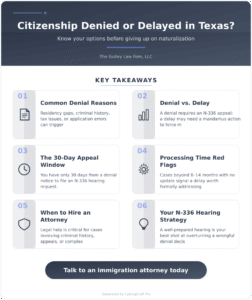
This guide focuses specifically on Texas residents whose citizenship applications have stalled or been denied, and what concrete steps can change that outcome.
Every year in 2025, thousands of applicants across Harris County, Fort Bend County, and surrounding Texas communities hit unexpected walls in the naturalization process. Some wait months past the standard processing window with no update. Others receive denial notices citing reasons that feel vague or even unfair. If that sounds familiar, here is what you should understand before giving up or making a move you might regret.
Why Citizenship Applications Get Denied or Delayed in Texas
Denial: A formal USCIS decision that your N-400 application does not meet the legal requirements for naturalization as determined at the time of review.
Processing delay: A situation where your application has been pending beyond the published USCIS processing window with no decision issued, often requiring a formal response to compel action.
The most common denial reasons include:
- Failure to meet the continuous residence or physical presence requirement
- Criminal history that raises good moral character concerns
- Outstanding tax obligations or selective service registration issues
- English language or civics test failure
- Errors or inconsistencies in the application itself
Delays are a separate problem. According to USCIS, average N-400 processing times in 2025 range from 8 to 14 months depending on the field office. The Houston field office, which handles many Sugar Land and Fort Bend County applicants, has historically run on the longer end of that range. A case sitting beyond that window without movement is a red flag worth addressing.
The most common mistake we see is applicants assuming delays are normal and waiting too long before asking questions or seeking help. By the time they act, critical deadlines have passed or the case has developed complications that could have been avoided.
Thinking about this for your situation? Let us talk. Contact us and we will walk you through your options with no pressure.
Denied vs. Delayed: Which Path Applies to You?
Denial vs. Delay – Side by Side
| Situation | USCIS Action | Your Response Window | Best First Step |
|---|---|---|---|
| Application Denied | N-336 Hearing Request Available | 30 days from denial notice | File N-336 or consult an attorney immediately |
| Case Delayed Beyond Published Times | No action taken | No hard deadline, but urgency matters | Submit service request or explore mandamus |
| RFE Issued (Request for Evidence) | Application on hold pending response | Within the deadline stated on your RFE notice | Respond completely and accurately |
| Interview Notice Pending | Processing in queue | Monitor USCIS case status online | Prepare documentation and legal support |
Where handling a denial yourself succeeds: Simple cases where the denial was based on a correctable error like a missing document or minor inconsistency.
Where handling a denial yourself fails: Cases involving criminal history, prior immigration violations, or complex residency calculations.
Where an attorney succeeds: Appeals, mandamus actions, cases with good moral character challenges, and situations where USCIS reasoning appears legally flawed.
Where an attorney may not be necessary: Straightforward delays where a simple USCIS service request resolves the issue within weeks.
The verdict: If your denial involved any legal determination about your character, history, or eligibility, get a legal review before filing an appeal. The N-336 hearing is your best shot, and a poorly prepared hearing response can close doors permanently.
Your Citizenship Application Action Plan
- Step 1 – Read the denial notice carefully: USCIS must state specific grounds for denial. Identify every reason listed before deciding on next steps.
- Step 2 – Check your appeal deadline: You have 30 days from the denial date to file Form N-336 requesting a hearing before an immigration officer. Missing this window eliminates your most direct option.
- Step 3 – Gather your full application file: Request your USCIS case file through the appropriate USCIS records request process so you and any attorney can review exactly what USCIS saw.
- Step 4 – Identify what can be corrected: Some denials are based on facts that can be rebutted with better documentation. Others require legal arguments about how the law should apply.
- Step 5 – Decide between N-336, re-filing, or federal court: These are your three primary paths. Each has different costs, timelines, and strategic implications.
- Step 6 – Act on delays with a mandamus if necessary: If your case has been pending significantly beyond the USCIS published timeline with no movement, a Writ of Mandamus filed in federal district court can compel USCIS to act.
Documents to Gather Before Your Attorney Consultation
- ☐ Copy of your N-400 application as submitted
- ☐ USCIS denial notice or most recent correspondence
- ☐ Your green card and any prior immigration documents
- ☐ Travel history records covering the relevant period for your application
- ☐ Tax returns for the past 5 years
- ☐ Any police records, court dispositions, or arrest history
- ☐ Selective service registration confirmation (if applicable)
- ☐ Proof of continuous residence (lease agreements, utility bills, employer letters)
When Getting an Attorney Involved Is Not Optional
Some situations genuinely allow for a do-it-yourself approach. A basic delay with a clean record and straightforward application? A service request or InfoPass appointment might resolve it. But there are situations where going alone creates real risk.
Get legal help immediately if your denial involved:
- Any reference to criminal history, even old or minor offenses
- Questions about your tax compliance or financial obligations
- Alleged misrepresentation or fraud, even unintentional
- Prior deportation orders or immigration violations
- Concerns about your good moral character determination
The USCIS Policy Manual on Naturalization outlines exactly how officers evaluate moral character, and the standards are more nuanced than most people expect. What seems like a resolved matter in your past can still affect eligibility depending on how it is presented.
At The Gulley Law Firm, LLC, we work with clients throughout Fort Bend County, Harris County, and the greater Sugar Land, TX area who are navigating exactly these situations. Our approach is direct. We tell you what your file actually shows, what options are realistic, and what the process looks like from here.
See how our approach to adjustment of immigration status and related immigration matters works for Texas clients.
Key Takeaways for Texas Applicants in 2025
- A denial is not permanent – The N-336 hearing process exists specifically to challenge USCIS decisions, but the 30-day window moves fast.
- Delays beyond 14 months deserve action – A mandamus petition in federal court is a real and effective tool for unreasonable USCIS inaction in 2025.
- Criminal history is the most common complication – Even minor offenses require careful legal analysis before filing an appeal.
- Documentation quality matters – Most denial cases involve gaps in evidence that could have been addressed with stronger supporting documents from the start.
- Texas applicants have Houston field office-specific timelines – Current processing in 2025 at the Houston office runs longer than the national average, so building extra time into your strategy matters.
Frequently Asked Questions
How long does USCIS have to process my citizenship application?
USCIS does not have a legally mandated deadline for processing N-400 applications, but current 2025 processing times average 8-14 months nationally. If your case has been pending significantly beyond that window, you have options including a formal service request or a Writ of Mandamus in federal court to compel action.
Can a citizenship application denial be appealed?
Yes. You can request a hearing using Form N-336 within 30 days of receiving your denial notice. If the N-336 hearing also results in denial, federal district court review is still possible in certain circumstances.
Does a criminal record automatically disqualify me from citizenship?
Not automatically, but it significantly complicates the application and requires careful legal analysis. The impact depends on the nature of the offense, when it occurred, and how it was resolved. An attorney review before filing an appeal is strongly recommended.
What is a Writ of Mandamus in the context of a citizenship delay?
A Writ of Mandamus is a federal court petition that compels a government agency to act on a pending matter within a reasonable time. It is used when USCIS delays extend far beyond normal processing windows and informal requests have failed to produce movement.
How much does it cost to appeal a citizenship denial in Texas?
The N-336 filing fee is $700 (2025 USCIS schedule), not including attorney fees. Attorney fees for immigration appeals vary based on case complexity. Most immigration attorneys in Texas offer initial consultations to give you a realistic cost picture before you commit.
Can I re-file my N-400 instead of appealing?
Yes, re-filing is an option, but it is not always the right strategic choice. Re-filing means starting the process over with a new fee and new timeline, and the same underlying issues will need to be addressed. An attorney can help you decide whether an appeal or a new application gives you the stronger path forward.
How do I know if my delay is normal or a red flag?
Check the current processing time for the Houston USCIS field office at USCIS.gov and compare it to your receipt date. If your case falls outside that published window, submit an online service request. If there is still no movement after 30-60 days, that is when legal intervention becomes worth considering.