


An emergency restraining order in Texas is a court-issued legal directive that immediately restricts another person’s contact or proximity to you, typically granted the same day you file without the other party being present. These orders exist because some situations simply can’t wait for a scheduled court hearing.
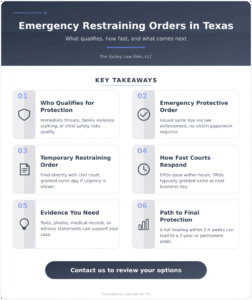
This guide focuses specifically on Texas emergency protective orders, temporary restraining orders in family law cases, and what actually happens after the court grants one.
If someone in your life is threatening you, has hurt you, or is making it impossible for you to feel safe, knowing your legal options fast matters. According to the Texas Attorney General’s Office, family violence affects thousands of Texas households each year, and emergency orders are often the first line of legal protection available.
What Actually Qualifies for an Emergency Restraining Order in Texas
Texas courts recognize a few distinct types of emergency orders, and not every situation qualifies. Here is what the law generally looks for:
- A credible, immediate threat of physical harm or family violence
- Documented or demonstrable harassment, stalking, or abuse
- Situations involving children where safety is at risk
- Sexual assault or trafficking circumstances
Family Violence Protective Order: A court order that prohibits an abusive household member from contacting, threatening, or coming near the protected person, often issued the same day as filing in emergency situations.
Temporary Restraining Order (TRO): A short-term court order typically used in civil or family law matters – like divorce or custody cases – to preserve the status quo and prevent harmful actions until a full hearing is held.
The key distinction is urgency. If you are in immediate danger, Texas courts can issue what is called an Emergency Protective Order (EPO) – often through law enforcement at the scene of a family violence incident. A TRO, by contrast, requires you to file paperwork with the court.
One thing people often misunderstand: you do not need a police report to request a TRO in civil court. You do, however, need enough evidence to convince a judge there is a genuine threat. That evidence might include texts, photos, medical records, or witness statements.
How Fast Can Texas Courts Issue an Emergency Restraining Order?
Speed is the whole point of these orders. Here is a realistic breakdown:
| Order Type | Issued By | Timeline | Duration |
|---|---|---|---|
| Emergency Protective Order (EPO) | Judge or magistrate (via police) | Same day – at scene of incident | 31-91 days |
| Temporary Restraining Order (TRO) | Civil/family court judge | Same day or next business day after filing | Up to 20 days (extendable) |
| Temporary Protective Order | Family court judge | Within 24-72 hours of application | Up to 20 days (renewable) |
| Final Protective Order | District or county court | After full hearing (typically 2-4 weeks) | Up to 2 years or permanent |
An EPO is the fastest route – law enforcement can request one from an on-call judge on your behalf, often within hours of a domestic violence call. A TRO filed with the family court in Fort Bend County or Harris County can typically be heard the same day if the situation is urgent enough.
Texas family courts are designed to respond quickly to emergency applications, and many counties maintain dedicated family law dockets to help move urgent matters forward without unnecessary delay.
Thinking about this for your situation? Let’s talk. Contact us and we’ll walk you through your options with no pressure and no confusing legal jargon.
Emergency Protective Order vs. Temporary Restraining Order: Which Approach Works?
Where an EPO succeeds: Issued immediately at the scene of a family violence incident, requires no paperwork from the victim, and is enforced by law enforcement from day one.
Where an EPO fails: You have no direct control over whether one is issued – law enforcement makes that call. EPOs also have a short shelf life and require follow-up action to maintain protection long-term.
Where a TRO succeeds: You control the filing, it can address property issues and child custody alongside contact restrictions, and it sets the stage for a longer-term protective order from the court.
Where a TRO fails: It requires you to appear before a judge (even in an ex parte hearing), demands documentation, and lapses if you do not pursue the full hearing within the order’s active window.
The verdict: If you are in immediate physical danger, call 911 and request an EPO through law enforcement – that is the fastest path. If the threat is serious but not at a boiling point right this minute, filing for a TRO through the court gives you more control over the terms and sets up a path to longer protection.
Your Emergency Order Action Plan
- Step 1 – Document everything now: Screenshot threatening messages, photograph injuries, write down dates and descriptions while memory is fresh. This documentation directly affects whether a judge grants your request.
- Step 2 – Decide which order fits: Active violence or immediate threat – call 911 for an EPO. Serious but not immediate danger in a family law context – file for a TRO at your county courthouse.
- Step 3 – File your application: Visit the district clerk’s office in Fort Bend County or Harris County. Bring your documentation and any police report numbers. Ask the district clerk’s office about fee waiver options that may be available when you file.
- Step 4 – Attend the ex parte hearing: For a TRO, the judge may hear your side without the other party present. Be specific, calm, and factual.
- Step 5 – Prepare for the full hearing: Your TRO is short-term. Use that time to build your case for a longer protective order with the help of an attorney.
- Step 6 – Understand enforcement: Carry a copy of your order everywhere. Violations are a criminal offense in Texas – report them immediately to law enforcement.
What Happens After the Order Is Granted
Getting the order is step one. What comes next matters just as much.
After a Texas court grants a TRO or protective order, the restrained party must be formally served. Until service is completed, enforcement is limited. Once served, the order is entered into the statewide family violence database and is enforceable by any Texas law enforcement agency.
The most common mistake people make at this stage is assuming the piece of paper alone keeps them safe. It is a legal tool, not a physical barrier. If the person violates the order, call 911 immediately and document everything. Violations can result in jail time and strengthen your case for a long-term order.
Within the TRO window, the court will schedule a hearing where both sides can present evidence. This is where having legal representation makes a real difference. According to recent Texas family court data, represented petitioners are significantly more likely to receive longer-term protective orders than those who appear without counsel.
For families in Sugar Land, Richmond, and across Fort Bend County, The Gulley Law Firm, LLC handles these matters with the kind of direct, plain-spoken approach that actually helps people understand what they are facing. Learn more about our legal services and how we protect our clients across Harris County and Fort Bend County.
Documents to Gather Before Filing
- ☐ Screenshots or printouts of threatening texts, emails, or social media messages
- ☐ Photos of injuries or property damage with timestamps
- ☐ Police report numbers from any prior incidents
- ☐ Medical records documenting treatment for injuries
- ☐ Names and contact information of witnesses
- ☐ Prior court orders or case numbers if any exist
- ☐ Your Texas ID and the respondent’s full legal name and address
Key Takeaways for Texas Residents in 2025
- Speed is available – Texas courts can issue emergency orders the same day in genuine threat situations, especially in Fort Bend and Harris County family courts.
- Two main paths exist – EPOs through law enforcement for active danger, TROs through the court for serious but non-immediate threats.
- Documentation is everything – judges base emergency orders on evidence you bring, so gather records before you file.
- The order is only the beginning – you must attend the follow-up hearing to maintain protection beyond the initial order period.
- Violations must be reported – every violation documented strengthens your long-term case and is a criminal offense under Texas law.
Frequently Asked Questions
How long does an emergency restraining order last in Texas?
A Texas Temporary Ex Parte Protective Order lasts up to 20 days, an EPO lasts between 31 and 91 days, and a full protective order can last up to two years or be made permanent in certain situations. To extend protection beyond the initial order, you must attend the court hearing and present your case for a longer-term order.
Can I get an emergency restraining order without a lawyer in Texas?
Yes, Texas residents can file for a TRO without an attorney, and courthouse staff can often help you locate the correct forms. That said, having legal representation at the follow-up hearing significantly improves the likelihood of receiving a longer-term protective order.
Does an emergency restraining order in Texas cover child custody?
A TRO filed in a family law case can include temporary custody and visitation restrictions alongside contact prohibitions. This makes the TRO a powerful tool in divorce and custody situations where a parent’s behavior poses a risk to children.
What happens if someone violates an emergency restraining order in Texas?
Violating a Texas protective order is a criminal offense that can result in arrest, fines, and jail time. Call 911 immediately if a violation occurs, document the incident, and notify your attorney so the violation can be presented to the court.
How much does it cost to file for a restraining order in Texas?
Filing fees vary by county and depend on the type of order being sought. Victims of family violence may qualify for a fee waiver – ask the district clerk’s office about the waiver application when you file.
Can a restraining order be issued against me if the other person files first?
Yes, Texas courts can issue mutual restraining orders in some cases, particularly during divorce proceedings. If you have been served with a TRO, you have the right to contest it at the scheduled hearing – do not ignore it or assume it will go away.
Do emergency restraining orders in Texas show up on background checks?
Final protective orders are entered into Texas statewide databases and can appear in background checks, while temporary orders vary by how records are maintained. If a protective order is entered against you, consult with an attorney promptly because the long-term consequences can extend well beyond the original family law case.
Your Next Step
If you or someone you care about is in a dangerous situation right now, do not wait to see how things play out. Texas courts have emergency tools for exactly this reason, and the process moves faster than most people expect when you come prepared.
The team at The Gulley Law Firm, LLC, serving clients throughout Sugar Land, Fort Bend County, and Harris County, handles family law matters with directness and genuine care. Attorney Miechia L. Gulley has built a practice around being accessible, clear, and fiercely focused on her clients’ outcomes – including working with payment arrangements because legal help should not be out of reach when you need it most.
Ready to take the next step? Contact us today for straight answers and real guidance on emergency restraining orders in Texas. We serve families across Fort Bend County, Harris County, Richmond, Sugar Land, Missouri City, Stafford, Rosenberg, and surrounding communities. You can also reach us directly at (832) 990-2116.
This content is for general informational purposes only and does not constitute legal advice. Every situation is different. Please consult with a licensed Texas attorney for guidance specific to your circumstances.